
Vesting schedules
Create cliff, linear, or stepped token release schedules.
Vesting deposits the full allocation into an isolated vault and releases it according to immutable chain timestamps. A beneficiary may claim multiple times; each claim transfers only newly vested base units.
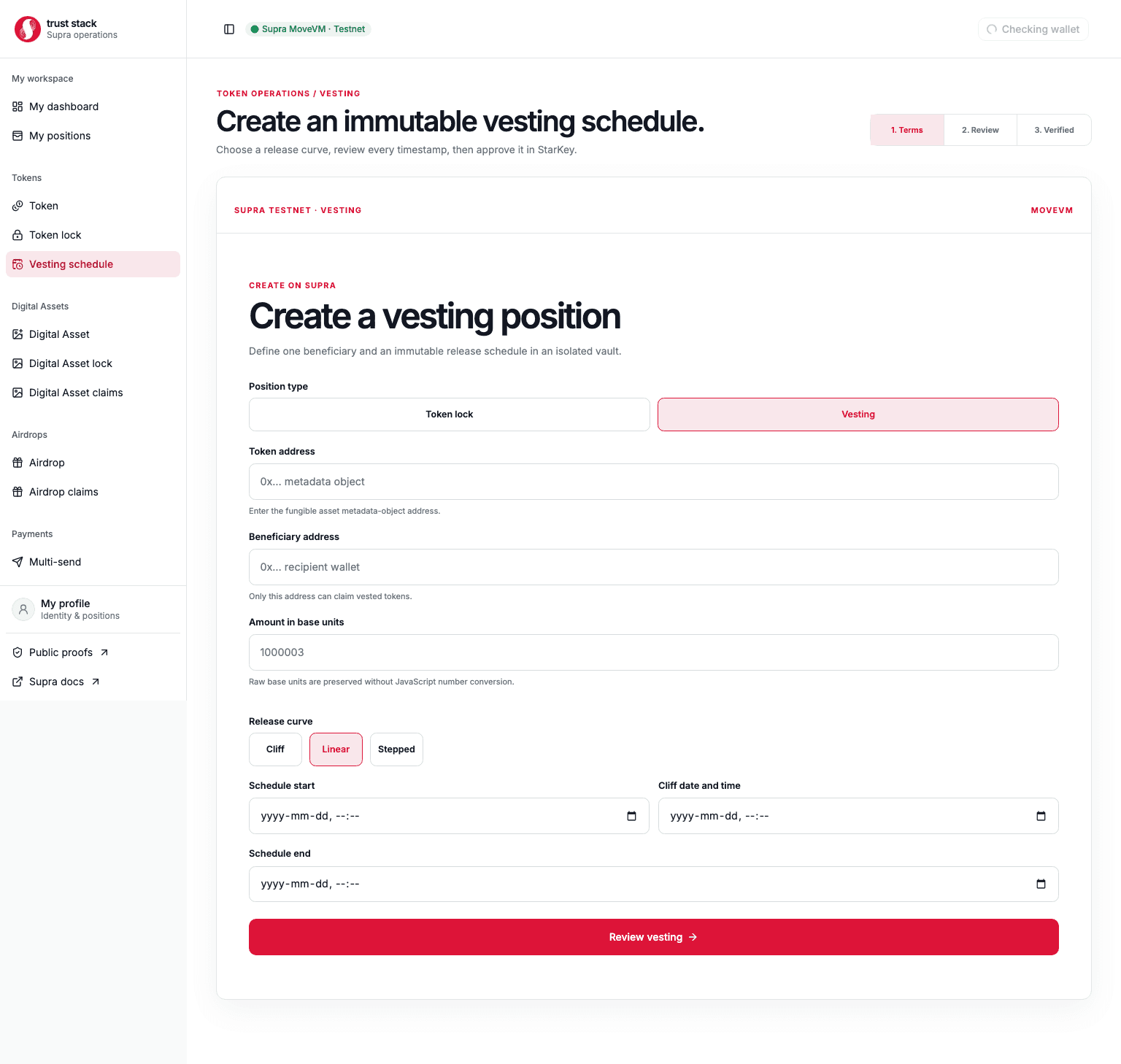
Schedule types
| Schedule | Release behavior |
|---|---|
| Cliff | Nothing releases before the cliff; the full allocation releases at the configured end. |
| Linear with cliff | Nothing releases before the cliff, then cumulative vested value grows linearly through the end. |
| Stepped | The allocation releases in uniform discrete steps between the configured boundaries. |
Create a schedule
- Verify the token metadata address and wallet balance.
- Enter the total allocation and beneficiary.
- Choose a schedule and set valid UTC boundaries.
- For stepped vesting, choose the bounded number of release steps.
- Review the timeline, exact base units, and expected first claim.
- Sign once; save the vesting object address.
Claim vested tokens
Claims calculate cumulative vested value from the current on-chain timestamp, subtract the already claimed amount, and transfer only the difference. The final eligible claim transfers the exact remainder so integer rounding cannot strand value.
Guarantees
- The full allocation is funded atomically at creation.
- The schedule, token, beneficiary, and amount are immutable.
- Only the beneficiary can claim.
claimed ≤ vested ≤ totalis enforced in integer base units.- Claiming one schedule cannot change another schedule.
There is no creator cancellation, revocation, pause, beneficiary replacement, or emergency seizure path in the v1 schedule.